
Armor in RuneScape: Dragonwilds determines your displayed power level and provides separate defence values against melee, ranged, and magic attacks. The practical rule is to wear the highest power-level armor you can currently obtain, then choose melee, ranged, or magic pieces according to the attacks and combat bonuses that matter to your build.
There is no single best set for every character. Melee armor has the strongest melee defence and bonuses built around blocking and stagger. Ranged armor favors stealth, ranged stamina efficiency, and weak-point damage. Magic armor provides the best magic defence while improving stamina recovery and spell performance. You can mix classes, but doing so trades the three-piece bonus of one class for smaller bonuses from multiple classes.
Armor is not complete protection. Defence on an item is not a guaranteed percentage reduction against every hit, and most pieces lose durability during combat, falls, and failed vault traps. Keep armor repaired and continue blocking, parrying, dodging, and using suitable supplies.
Choose an armor class by combat plan
Pick a class by the actions you perform most often, not only by which set has the largest-looking defence number.
| Combat plan | Best starting class | What the class supports | Main limitation |
|---|---|---|---|
| Fight at close range with a shield | Melee | Cheaper blocks, critical hits after blocking, and more damage against staggered targets | Lower ranged and magic defence than equal-level specialist sets |
| Attack weak points with bows or crossbows | Ranged | Faster stealth movement, lower ranged attack stamina cost, and stronger weak-point hits | Less melee protection than heavy armor at the same power level |
| Cast frequently and rely on movement | Magic | Shorter stamina regeneration delay, faster magic attacks, and more magical critical hits | Lowest melee defence among the three standard classes |
| Change weapons during one expedition | Mixed | Lets you combine useful one-piece and two-piece bonuses | Gives up a complete three-piece class bonus |
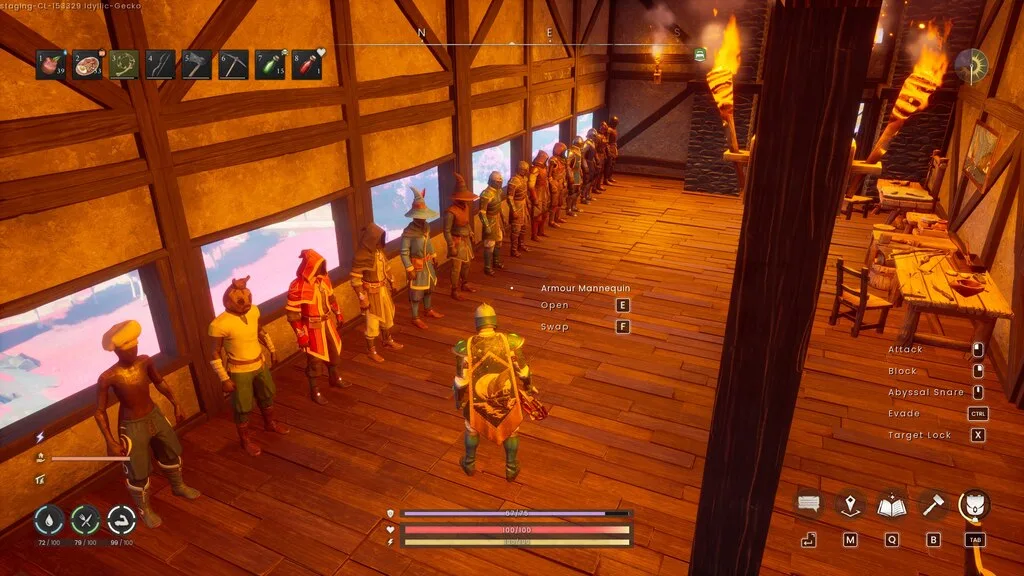
Use the displayed mannequins to compare the silhouettes of different armor sets.
The class name does not lock your weapon. A character can use a bow, staff, or melee weapon while wearing another armor class. What changes is the defensive profile and which set bonuses are active. This makes mixed armor viable, but a complete matching set is the simplest choice when your build has one clear combat style.
Armor set bonuses explained
A standard class set uses three counted pieces: head, body, and legs. Equipping one, two, or three pieces from the same class activates progressively stronger bonuses.
| Pieces equipped | Melee armor | Ranged armor | Magic armor |
|---|---|---|---|
| 1 of 3 | 33% lower block stamina cost | +40 stealth speed | 50% shorter stamina regeneration delay |
| 2 of 3 | +50% critical chance after blocking | 33% lower ranged attack stamina cost | +10% magic attack speed |
| 3 of 3 | +25% damage to staggered targets | +25% weak-point damage | +15% magical critical chance |
The one-piece magic bonus is particularly easy to combine with another class because it changes the delay before stamina begins recovering. For example, one magic piece with two melee pieces activates the first magic bonus and the first two melee bonuses. Use pieces of the same power level when possible so the hybrid setup does not lower your displayed power level.
A full set is usually better when its three-piece effect directly matches your main damage plan. Melee characters who consistently block and stagger gain value from all three melee effects. Accurate ranged characters benefit from the complete weak-point package. Dedicated spellcasters gain both casting speed and magical critical chance from a full magic set.
Match armor power level to the region
Your displayed power level is based on the armor currently equipped. When pieces from different power levels are mixed, their levels are averaged and rounded down. A single outdated piece can therefore keep the displayed value below the level of the other two pieces.
Use this progression table to identify the normal three-piece options at each power level. Sets listed in the same cell are alternatives at that level rather than automatic upgrades over one another.
| Power level | Melee sets | Ranged sets | Magic sets |
|---|---|---|---|
| 2 | Reinforced | Leather | Apprentice |
| 3 | Bronze | Hard Leather | Wizard |
| 4 | Iron, Paladin, Gilded Paladin | Studded Leather, Wild Archer | Dark Mage, Dragonkin Mage |
| 5 | Steel, Fallen Hoplite, White | Green Dragonhide, Ranger | Splitbark, Necromancer |
| 6 | Mithril, Black Knight | Blue Dragonhide, Shadow | Mystic, Zamorak |
| 7 | Adamant, Obsidian | Red Dragonhide, Kalphite Carapace | Infinity, Lunar Garou |
| 8 | Rune | Black Dragonhide | Ancestral |
| 9 | Dragon | — | — |
The three classes progress in parallel through power level 8. Dragon armor is the listed power-level-9 heavy set. Its Full Helm, Platebody, and Platelegs come from the Queenslayer’s Reward Pack rather than a crafting recipe, and these Dragon pieces do not degrade.
Desert robes are not used as the power-level-7 magic benchmark here because the available armor data does not list their melee, ranged, or magic defence values. Infinity and Lunar Garou provide confirmed power-level-7 magic progression.
Craft the early armor tiers efficiently
Power-level-2 armor can be made at a Crafting Table. Standard armor from power level 3 onward is made at an Armour Bench. Some alternative sets also require a vault discovery, a purchased recipe vestige, a special merchant, a quest reward, or Deluxe Edition access.
Do not collect materials for all three classes unless you intend to use them. Commit to one complete early set, then keep materials for the next power level and any gathering tools needed to reach its resources.
Power-level-2 set totals
| Set | Materials for head, body, and legs |
|---|---|
| Reinforced | 22 Animal Bone and 16 Leather |
| Leather | 22 Leather and 16 Coarse Thread |
| Apprentice | 22 Coarse Thread and 16 Rune Essence |
Reinforced is the direct heavy option, Leather supports ranged combat, and Apprentice supplies the first magic-class bonuses. All three reach the same power level, so the correct choice is the class package you want rather than whichever recipe appears most expensive.
Power-level-3 set totals
| Set | Materials for the complete set |
|---|---|
| Bronze | 20 Bronze Bar, 8 Hard Leather, and 7 Wool Thread |
| Hard Leather | 20 Hard Leather, 10 Wool Thread, and 5 Bronze Bar |
| Wizard | 18 Rough Cloth, 12 Wool Thread, and 7 Wild Anima |
This is the point where the Armour Bench becomes central to armor progression. If a recipe has not appeared, confirm that the required material has been discovered and brought back to the appropriate crafting station.
Power-level-4 set totals
| Set | Materials for the complete set |
|---|---|
| Iron | 20 Iron Bar, 14 Hard Leather, 6 Padded Cloth, and 6 Vault Shard |
| Studded Leather | 20 Hard Leather, 10 Iron Bar, 9 Padded Cloth, and 6 Vault Shard |
| Dark Mage | 17 Padded Cloth, 14 Hard Leather, 7 Silver Bar, and 6 Vault Shard |
Paladin, Wild Archer, and Dragonkin Mage are alternative power-level-4 sets with the same defensive values as Iron, Studded Leather, and Dark Mage respectively. Their recipes have separate unlock routes: Paladin recipes come from the Takla Karadragonkin vault, Wild Archer recipes from the Kletterbuja Karadragonkin vault, and Dragonkin Mage recipes from the Chaktan Karadragonkin vault. Gilded Paladin is another heavy alternative tied to the Deluxe Edition.
Because these alternatives do not increase the basic defence values over their standard class equivalents, do not delay a necessary power-level upgrade merely to obtain one. Craft the standard set first when survivability is the immediate problem, then pursue the alternate appearance or recipe afterward.
Continue the armor progression after power level 4
From power level 5 onward, armor recipes use materials associated with each new stage of exploration. Upgrade your gathering tools and crafting infrastructure alongside your armor; reaching a stronger material does not help if you cannot harvest, refine, or use it.
A straightforward class route is:
- Move from Iron, Studded Leather, or Dark Mage into a power-level-5 set. The standard choices are Steel for melee, Green Dragonhide for ranged, and Splitbark for magic.
- Replace that set with Mithril, Blue Dragonhide, or Mystic at power level 6. Black Knight, Shadow, and Zamorak are alternate sets at the same level.
- Enter power level 7 with Adamant, Red Dragonhide, or Infinity. Obsidian, Kalphite Carapace, and Lunar Garou provide additional class-specific choices.
- Build the power-level-8 Rune, Black Dragonhide, or Ancestral set when their materials become available.
- Treat Dragon armor as the separate power-level-9 heavy endpoint rather than a craftable Rune upgrade.
Many alternate sets use different materials or unlock methods while retaining the defensive profile of the standard set at that power level. Choose between equal-level sets by recipe access, material cost, and the appearance you want. The class bonus is determined by the armor class, not by whether the set is the standard or alternate version.
Decide when to mix armor classes
Mixing is worthwhile only when the lower-stage bonuses serve a specific plan. Use these combinations as decision patterns rather than mandatory builds:
- Two melee pieces and one magic piece: keeps reduced block stamina cost and the critical bonus after blocking while adding the shorter stamina regeneration delay. This suits a shield user who values stamina recovery more than the melee three-piece stagger-damage bonus.
- Two ranged pieces and one magic piece: keeps stealth speed and reduced ranged attack stamina cost while adding faster stamina recovery. It sacrifices the ranged three-piece weak-point damage bonus.
- A complete melee set: best when blocking, staggering, and punishing staggered targets form one continuous combat loop.
- A complete ranged set: best when you can consistently strike weak points and want the full ranged damage bonus.
- A complete magic set: best when frequent spell attacks and magical critical hits matter more than extra protection against physical attacks.
Check the power level after every swap. Combining two high-level pieces with one much older utility piece can round the average down. If that leaves you under the level of the enemies or area, the utility effect may not justify the loss.
Treat shields, capes, and utility gear separately
Shields occupy the off-hand slot rather than one of the three class armor slots. Blocking reduces incoming damage according to the shield’s block value. Starting a block as an attack arrives performs a parry, produces an audible clang, and staggers enemies that are not immune. A shield can therefore reinforce a melee armor build, but it does not complete the head-body-legs melee bonus.
Capes occupy the back slot. Most provide only minor defence and are primarily cosmetic, although individual capes can have special effects or specific quest and activity unlocks. Evaluate a cape on its own property instead of treating it as a replacement for one of the three main armor pieces.
Some wearable items are designed for utility rather than combat. Leggings of Lightness provide +50 carry weight but no defence. The Lumber Backpack provides a +15% special-item drop chance and is connected to Woodcutting progression. These can be useful during resource runs, but they lower combat protection if they replace a defensive piece.
Fix common armor progression problems
The displayed power level is lower than expected
Inspect all three main armor slots. Mixed power levels are averaged and rounded down, so one lower-level head, body, or leg piece can reduce the displayed result. Replace the oldest piece or use three pieces from the same current tier.
A new armor recipe is missing
Confirm the required material has been discovered, carried back to the base, and checked at the correct station. Standard power-level-3 and higher armor uses the Armour Bench. Alternative recipes may instead require vault exploration, a recipe vestige, a merchant purchase, a quest, or Deluxe Edition ownership.
A special set has the same defence as standard armor
That is normal for several alternatives. Paladin matches Iron, Wild Archer matches Studded Leather, and Dragonkin Mage matches Dark Mage in their listed defence values. These sets offer another recipe and appearance, not a higher power level.
A full armor upgrade does not prevent lethal hits
Armor defence is not a promise of a fixed damage reduction against every attack. Check whether the set specializes against the damage type you are receiving, verify its durability, and continue using movement, blocking, parrying, food, and other combat preparations. A higher power level improves readiness, but it does not replace combat mechanics.
The build feels short on stamina
Decide which bonus you are missing. Melee armor reduces block stamina cost, ranged armor reduces ranged attack stamina cost, and one magic piece shortens the stamina regeneration delay. A deliberate mixed set may solve the problem, but compare that benefit against the three-piece bonus and any power-level loss before committing.